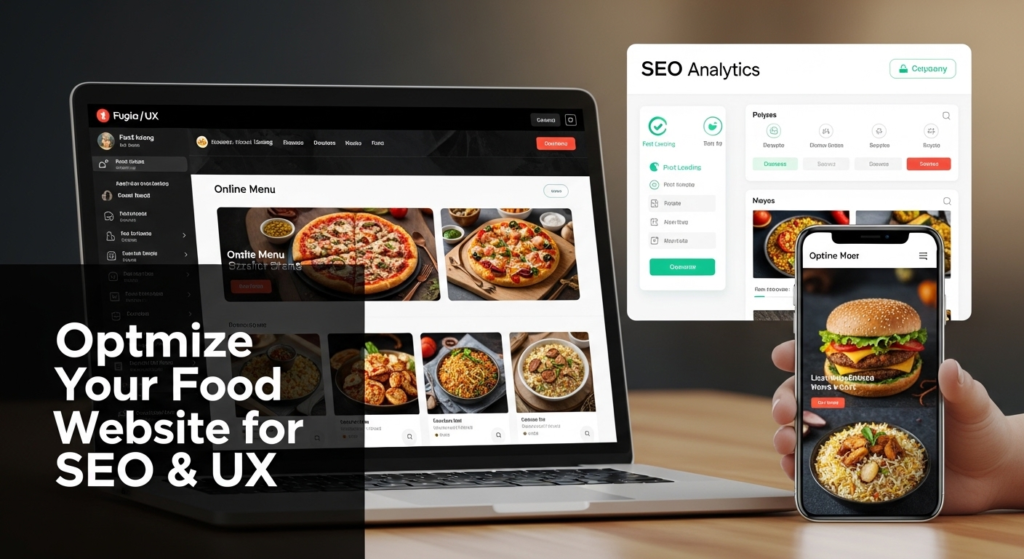
In today’s digital-first world, your website is often the first interaction customers have with your food business. Whether you run a restaurant, bakery, cloud kitchen, or catering service, having a well-optimized website is no longer optional; it’s essential.
By combining Search Engine Optimization (SEO) and User Experience (UX), food businesses can attract more visitors, keep them engaged, and convert them into loyal customers. Add Voice Search Optimization (VSO) into the mix, and your website becomes a powerful tool for capturing modern, on-the-go users.
In this guide, you’ll discover practical strategies to improve your website’s performance and drive real results.
Why Website Optimization Matters for Food Businesses

First Impressions & Customer Trust
Your website acts as your digital storefront. A clean, fast, and visually appealing design builds trust instantly, while a slow or outdated site can push customers away.
Impact on Online Orders & Reservations
A well-optimized website simplifies the ordering or booking process, increasing conversions and reducing drop-offs.
Google Rankings & Visibility
SEO ensures your business appears when people search for terms like “best biryani near me” or “top restaurants in Karachi.”
SEO Tips for Food Business Websites
Use Local SEO to Attract Nearby Customers
Local SEO is critical for food businesses.
- Optimize your Google Business profile
- Use location-based keywords like “BBQ restaurant in Karachi”
- Ensure your name, address, and phone number (NAP) are consistent
Optimize for Food-Related Keywords
Focus on keywords your customers actually search:
- Menu-specific: “chicken tikka price”
- Intent-based: “family dinner restaurants near me”
- Long-tail keywords for voice search
Optimize Meta Titles & Descriptions
Your meta title and description should:
- Include primary keywords
- Be engaging and click-worthy
- Clearly describe your offering
Add Structured Data (Schema Markup)
Schema helps search engines understand your content better.
Use:
- Local business schema
- Menu schema
- FAQ schema
This increases your chances of appearing in featured snippets and rich results.
UX (User Experience) Tips That Increase Conversions
Mobile-Friendly Design is Non-Negotiable
Most users browse food websites on mobile devices. Your site must:
- Be responsive
- Load properly on all screen sizes
- Offer easy navigation
Fast Loading Speed
A delay of even 2–3 seconds can cause users to leave.
Improve speed by:
- Compressing images
- Using fast hosting
- Minimizing unnecessary scripts
Easy Navigation & Clear Menu Layout
Make it effortless for users to find what they want.
- Keep menus simple and organized
- Highlight popular dishes
- Use clear categories
Clear Call-to-Actions (CTA)
Guide users with strong CTAs like:
- Order Now
- Reserve a Table
- View Menu
Place them prominently across your site.
Voice Search Optimization (VSO) for Food Businesses
Use Conversational Keywords
People use natural language in voice searches:
- “Where can I find the best pizza near me?”
Include these phrases naturally in your content.
Answer Common Questions (AEO Strategy)
Structure your content to answer questions directly. This improves your chances of ranking in:
- Featured snippets
- Voice search results
Optimize for “Near Me” Searches
Ensure your site includes:
- Location pages
- Maps integration
- Local keywords
Content Strategies That Boost SEO & Engagement
Add High-Quality Food Images
Visual content plays a huge role in food businesses. Use:
- Professional photos
- Optimized image sizes
- Descriptive alt text
Publish Blogs & Recipes
Content marketing helps you rank for more keywords and engage your audience.
Examples:
- Recipes
- Cooking tips
- Food trends
Customer Reviews & Testimonials
Social proof builds trust and improves conversions. Display reviews prominently.
Technical SEO Essentials
Secure Website (HTTPS)
Security is a ranking factor and builds user trust.
Fix Broken Links
Broken links harm both UX and SEO. Regularly audit your site.
Optimize Images & Alt Text
Use descriptive alt text like:
- “Spicy chicken biryani in Karachi”
Common Mistakes to Avoid
- Slow-loading websites
- Poor mobile optimization
- Ignoring local SEO
- Complicated ordering systems
- Lack of clear CTAs
Conclusion
Optimizing your food business website requires a balance of SEO, UX, and VSO strategies. By improving your site’s visibility, usability, and performance, you can attract more customers and increase conversions.
Start with small changes like improving speed and adding local keywords, and gradually implement advanced strategies like schema markup and voice search optimization.
The result? A website that not only ranks higher but also delivers a seamless and satisfying user experience.
FAQs
What is SEO for food businesses?
SEO for food businesses involves optimizing your website to rank higher on search engines and attract more local customers.
How can restaurants improve website traffic?
By using local SEO, publishing content, optimizing keywords, and improving website speed and UX.
Why is UX important for food websites?
Good UX ensures visitors can easily navigate, find menus, and place orders, increasing conversions.
How do I optimize my menu for SEO?
Use keyword-rich descriptions, structured data, and clear formatting for better visibility.
What is voice search optimization for restaurants?
It involves optimizing your content for conversational queries like “best food near me” to capture voice search traffic.